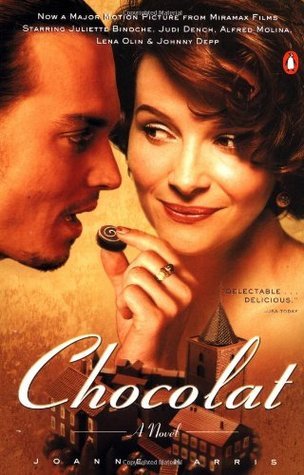
Author: Joanne Harris (b. 1964), Harris spent her early childhood living above her grandparents’ corner sweet shop in Yorkshire, a detail that makes the sensory richness of Chocolat feel deeply personal and authentic. She was a French teacher for 15 years before the surprise success of Chocolat. She was told by an agent that there was no market for “books set in rural France filled with self-indulgent descriptions of food”. Harris spoke only French until she started school at age five. This early sense of being an “other” in her community heavily informs her recurring themes of outsiders and outcasts.She writes her fantasy and Norse mythology novels under “Joanne M. Harris” to distinguish them from her literary fiction, proving she refuses to be boxed into a single genre.
Summary: Chocolat is a novel that tastes as good as it reads. The story follows Vianne Rocher and her young daughter, Anouk, as they drift into a tiny, repressed French village called Lansquenet-sous-Tannes. They are carried by “the north wind,” never staying anywhere for long.
Against the backdrop of Lent – the season of fasting and restraint – Vianne does the unthinkable: she opens a luxurious chocolate shop called La Céleste Praline. The village is dominated by Francis Reynaud, the pious and controlling parish priest, who sees Vianne’s chocolates not as confections, but as a sinful temptation sent by the devil to corrupt his flock.
What unfolds is a quiet but delicious war between pleasure and piety, freedom and control. Vianne uses her uncanny intuition (some call it magic) to sense the secret desires of the villagers, offering them not just chocolate, but a catalyst for change. She befriends a bitter old woman estranged from her grandson, an abused wife, and a dying man clinging to his dog. When a band of “river rats” – free-spirited boat gypsies led by the handsome Roux – moors outside the village, Reynaud’s crusade against Vianne reaches a fever pitch, leading to a confrontation on Easter Sunday that will decide whether Vianne stays or continues to follow the wind.
Personal Opinion: You nailed it: this book reads like a dream. There is a rare, almost magical quality to the prose that makes the pages fly by. Harris has a gift for “visual expression”. You don’t just read about the chocolate; you smell it, you taste the bitter orange and the cinnamon, you feel the velvet texture on your tongue. It is a perfect example of “easy reading” that never feels dumbed down, only pleasantly immersive.
What I loved most is the moral complexity hiding beneath the cozy surface. You think you are reading a charming story about a chocolatier, but Harris is actually asking a very sharp question: Is religion a genuine path to God, or just a convenient tool for controlling people you don’t like? Reynaud is not a cartoon villain; he genuinely believes he is saving souls. His obsession with Vianne reveals more about his own repressed desires than about her witchcraft, which makes him a deeply tragic figure rather than a mere antagonist.
However, I must admit that the magic realism felt a bit… unconfident. The book hints that Vianne has real powers – she sees the future in chocolate dregs and her mother was a witch, but it never fully commits to the fantasy or fully rejects it for pure realism. It sits in a lukewarm middle ground where the magic feels more like a stylistic shrug than a necessity.
Regarding the criticism about the “open ending,” I see where you are coming from, but I think Chocolat handles it better than South of the Border. The ambiguity here – the question of whether Vianne will finally break her mother’s curse of wandering – feels intentional. It is the central theme of the book: can a woman who has only ever run away actually choose to stay? Leaving that question hanging in the air isn’t an oversight; it is the entire point of her journey.






Leave a Reply