
Author: Robin Sharma is a Canadian author, leadership expert, and motivational speaker best known for his books on personal development, leadership, productivity, and personal mastery. Before becoming a full-time writer, Sharma worked as a litigation lawyer. At the age of 25, he left his legal career and began publishing books focused on personal growth and achieving a more meaningful life.
His breakthrough came with The Monk Who Sold His Ferrari, which was initially self-published before being picked up for wider distribution. Since then, Sharma has written numerous international bestsellers, including “The 5AM Club”, “The Leader Who Had No Title”, “Who Will Cry When You Die?”, and “The Wealth Money Can’t Buy”. His books have sold more than 25 million copies worldwide and have been translated into more than 90 languages.
Beyond his writing, Sharma works as a leadership and performance advisor and has worked with organizations and executives from companies including Microsoft, Nike, NASA, Starbucks, and PwC. His work focuses on helping people improve their performance while developing greater purpose and personal fulfillment.
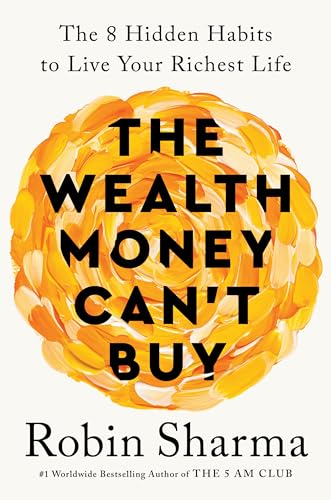
Summary: The Wealth Money Can’t Buy: The 8 Hidden Habits to Live Your Richest Life challenges the traditional idea that wealth is primarily measured by money, possessions, and financial success. Robin Sharma presents a broader concept of wealth based on eight different areas of life, arguing that financial prosperity is only one part of living a truly rich life.
The book is structured around Sharma’s 8 Forms of Wealth: Growth, Wellness, Family, Craft, Money, Community, Adventure, and Service. Each section explores one of these areas and introduces habits, ideas, and practical exercises that Sharma believes can help readers develop it.
Growth focuses on personal development, continuous learning, self-mastery, and becoming a better version of oneself. Wellness addresses physical and mental health, including habits intended to improve energy, vitality, and overall well-being. Family focuses on relationships with partners, relatives, and close friends, emphasizing the importance of investing time and attention in these connections.
The fourth area, Craft, concerns work and professional life. Sharma presents work not simply as a way to earn money but as an opportunity to develop skills, pursue excellence, and find purpose. Money, the fifth form of wealth, is not rejected or portrayed as unimportant. Instead, Sharma presents financial wealth as a tool that can provide freedom, choices, security, and the ability to support others.
The remaining forms of wealth focus on the social and experiential dimensions of life. Community deals with the people and social networks surrounding us, while Adventure encourages experiences, exploration, and stepping outside familiar routines. Finally, Service focuses on helping other people and contributing something meaningful beyond oneself.
Throughout the book, Sharma combines these eight areas with specific habits and practical exercises. Among the concepts he introduces are creating “perfect moments,” taking time away from distractions, reflecting on important relationships, and deliberately building routines that support personal growth. The book therefore moves between broader reflections on success and concrete practices intended to be incorporated into everyday life.
Overall, “The Wealth Money Can’t Buy” presents wealth as a multidimensional concept in which financial success is only one component. The book’s central framework connects personal development, health, relationships, meaningful work, finances, community, experiences, and service into a broader definition of what it means to live a rich and fulfilling life.
Personal opinion: I had quite high expectations for “The Wealth Money Can’t Buy” because I had heard a lot about Robin Sharma and his reputation as a personal development author. Unfortunately, the book did not live up to those expectations.
For me, the biggest issue was that the book felt rather superficial. Most of the individual pieces of advice are only about half a page to a page long. While this makes the book very easy and quick to read, I often felt that the ideas were introduced without being explored in much depth.
There are certainly many useful ideas and pieces of advice, but I didn’t find much that was particularly new or groundbreaking. As someone who has already read quite a few books about self-development, I recognized many of the concepts from other books. In that sense, the book felt more like a collection and repetition of familiar self-development ideas than something that offered me a new perspective.
If this is your first book about personal development, “The Wealth Money Can’t Buy” could be a good starting point because it covers many different areas of life in a simple and accessible way. However, if you have already read several books in this field, I would probably recommend spending your time on something more in-depth instead.








Leave a comment