
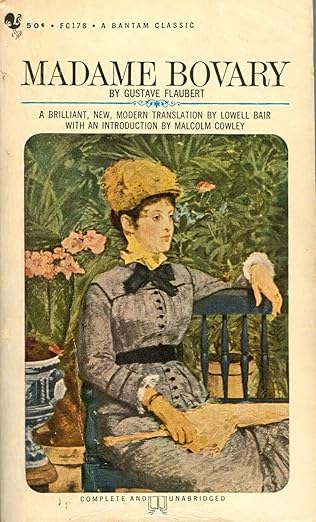
Author: Gustave Flaubert (1821–1880) The Perfectionist: Flaubert was famously obsessive about finding le mot juste (“the right word”). He would spend days or even weeks on a single page, sometimes rewriting a paragraph over 100 times to achieve perfect rhythm and precision. When Madame Bovary was first published as a serial in 1856, the French government immediately charged Flaubert with “offenses against public morals and religion.” He was acquitted, and the ensuing scandal made the book a massive bestseller.
“Madame Bovary, c’est moi”: When asked who the model for Emma Bovary was, Flaubert famously replied, “Madame Bovary, c’est moi” (“Madame Bovary is me”). He poured his own romantic frustrations and disgust with bourgeois life into her character.
Flaubert had a famously passionate but largely platonic relationship with the poet Louise Colet, but he never married. He once wrote that a writer must be “a monk in the modern world.”
Summary: Madame Bovary is often called the first true “realist” novel. It tells the story of Emma Bovary, a beautiful and restless young woman raised in a convent on a diet of romantic novels and sentimental poetry. She dreams of passion, luxury, and heroic love, the kind she has read about in books.
She marries Charles Bovary, a kind but painfully dull country doctor. Charles is a great and kind man, he adores her, but she finds him clumsy, boring and hopelessly provincial. Emma quickly becomes suffocated by the quiet tedium of domestic life in the small Norman village of Yonville. Desperate for the excitement she has read about, she begins to live beyond her means and takes two lovers. Each affair ends in betrayal and disappointment. To maintain her secret life and impress her lovers, Emma plunges her family into catastrophic debt with a ruthless moneylender. The novel follows her desperate attempts to escape a life she hates, culminating in one of the most famous and shocking endings in all of literature.
Personal Opinion: You have put your finger on exactly what makes Madame Bovary such a divisive book. Flaubert does not just critique his characters; he seems to take a cruel, almost sadistic pleasure in their humiliation. Emma is not merely flawed, she is systematically stripped of every shred of dignity. Her romantic illusions are mocked, her lovers are revealed as cowards, and even her death is rendered in excruciating, unglamorous detail. The same cold, clinical eye is turned on Charles, whose blind devotion is portrayed not as noble but as pathetic, and on Homais, the pompous pharmacist, whose hollow self-congratulation is paraded for all to see. There is no redemption, no sympathetic figure to hold onto. Flaubert holds his characters up under a microscope and dares you to find one admirable quality in them.
And yet, that is precisely the point. Flaubert was not writing a romance; he was writing an autopsy of a society he despised. The cruelty you feel is intentional. He once wrote that his book “is a work that is entirely lacking in kindness.” He wanted to show that the French bourgeoisie, with its petty materialism and emotional repression, was a factory that produced people exactly like Emma: dreamers without opportunity, lovers without passion, and failures without dignity.
However, whether that intention makes for an enjoyable reading experience is another question entirely. For a reader who wants to feel some warmth, some connection, or even a glimmer of hope for the characters, Madame Bovary can feel less like a story and more like a vivisection. Flaubert is not laughing with his characters; he is laughing at them, and he invites you to do the same. If you are not in the mood for that kind of cold, judgmental gaze, the book can easily leave you feeling empty and irritated rather than enlightened.







Leave a Reply