
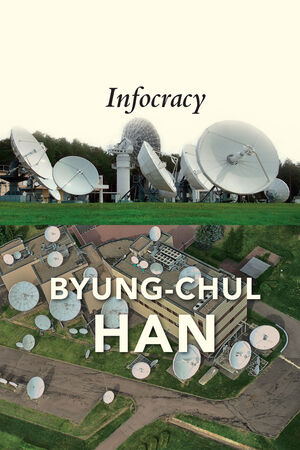
Author: Byung-Chul Han is a South Korean-born philosopher and cultural theorist known for his sharp critiques of modern society. His works explore themes like digitalization, burnout, and the pressures of neoliberalism. Having already reviewed The Burnout Society and The Palliative Society on my blog, his thought-provoking analysis continues to challenge how we perceive work, freedom, and human connection.
Summary: In “Infocracy”, Byung-Chul Han explores how the digital age has transformed political power, shifting from traditional democracy to a system where information control plays a dominant role. He argues that modern societies are no longer governed primarily by open debate and rational discourse but by an overwhelming flood of information that manipulates public perception and opinion.
Han critiques the way digital platforms and algorithms shape political narratives, often reinforcing biases and creating echo chambers rather than fostering real democratic discourse. Unlike authoritarian regimes that control people through censorship, today’s “infocratic” systems are controlled by overwhelming individuals with constant, often contradictory, information. This excess of information does not lead to greater transparency or enlightenment but rather to confusion, disengagement, and manipulation.
He also highlights how attention economics influences political decision-making, with short, sensationalized content replacing in-depth discussions. Social media platforms, designed for engagement rather than truth, amplify populist and emotionally charged messages, making democracy increasingly fragile.
Han’s analysis suggests that in an era of infocracy, power is no longer concentrated in traditional institutions but is dispersed through digital networks that subtly shape how people think and act. He warns that this shift endangers critical thinking and democratic processes, leaving society vulnerable to misinformation and political control through data-driven strategies.
Personal opinion: Byung-Chul Han’s “Infocracy” highlights how the flood of digital information is reshaping democracy, not through censorship but through manipulation and distraction. Instead of fostering true discourse, social media and algorithm-driven news create echo chambers and emotional polarization. The book serves as a warning: in an age of constant information, critical thinking is more important than ever.





 BooksTerra
Leave a comment